
Academic Proficiency and Graduation Rate Trends Across Four Types of Public Schools in St. Louis City
By : Amy Shelton, Ph.D.
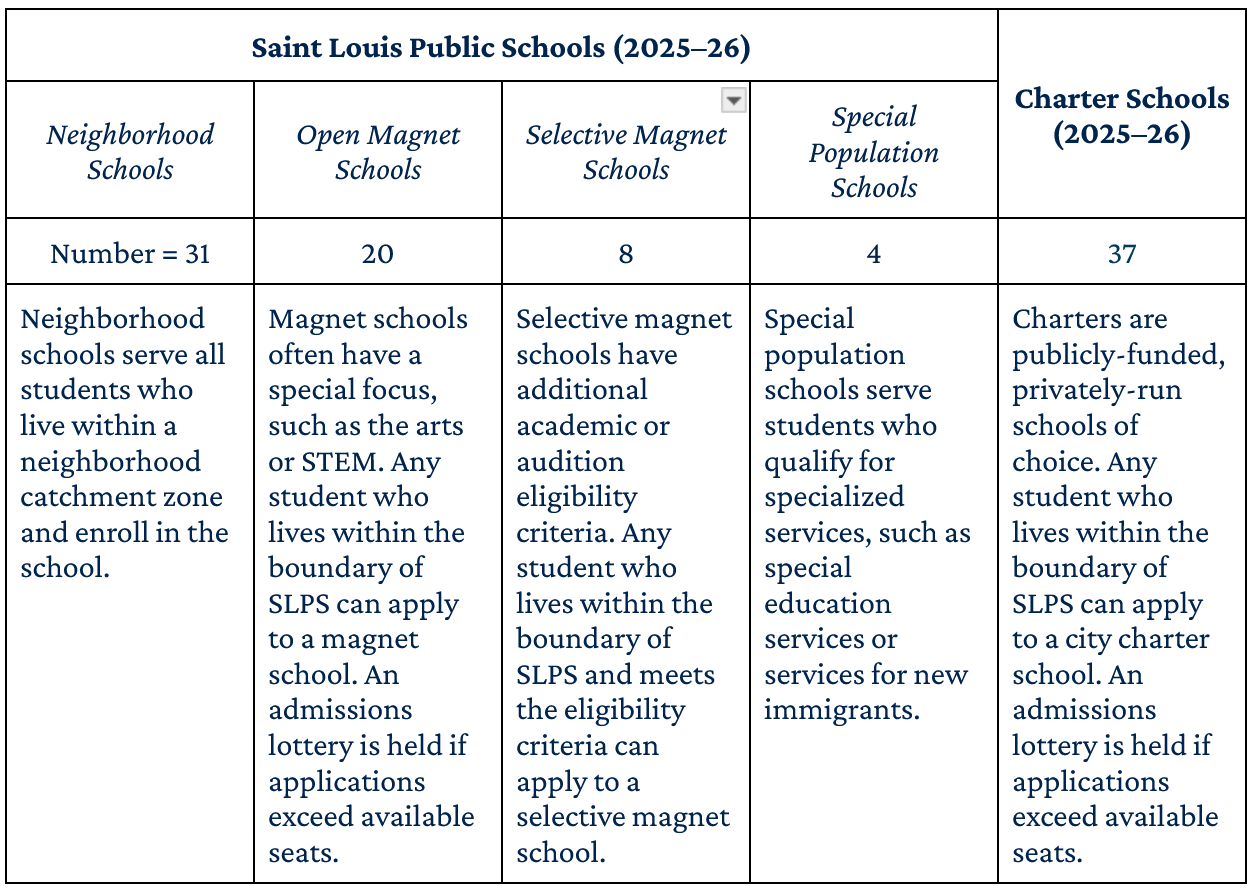
In this final blog in a four-part series, we examine academic proficiency and graduation rate trends from spring 2021 through spring 2025 across four types of public schools in St. Louis City: Saint Louis Public Schools (SLPS) neighborhood schools (31 schools in 2025–26), SLPS open magnet schools (20), SLPS selective magnet schools (8), and 37 public charter schools operated by 17 charter local education agencies (see definitions in Table 1). We exclude four SLPS special population schools.
The first blog in this four-part series examined three-year average English Language Arts (ELA) and Math growth across public school types. All public school types in St. Louis City have average three-year growth scores in ELA and Math that are above the state average of 85. Here we report on the percent of students who are scoring at the proficient or advanced levels in ELA and Math, for schools serving elementary and middle-grade students (77 of 100 public schools).
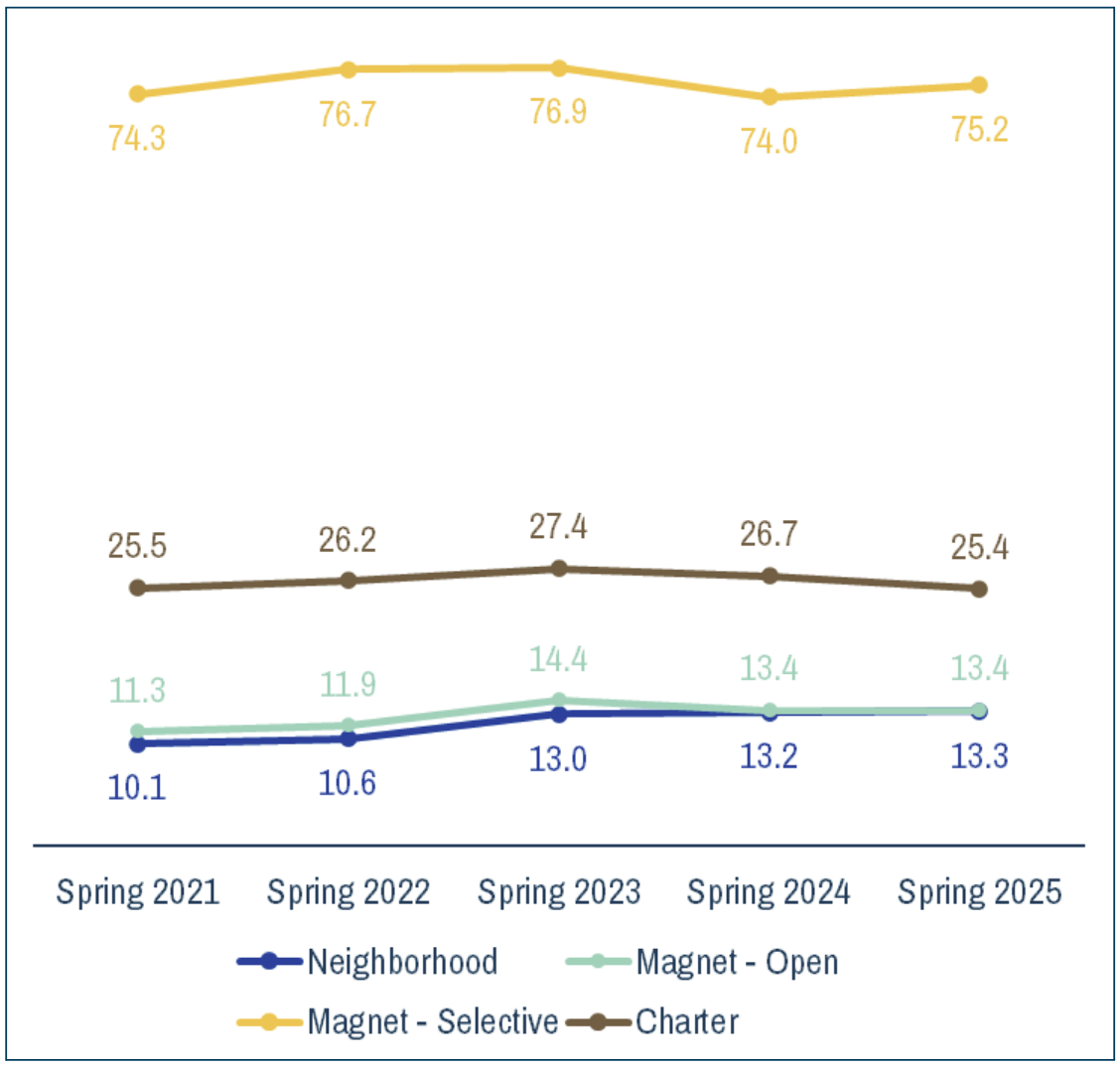
ELA proficiency has been flat across all public school types post-pandemic. Selective magnets have the highest proficiency rates in both ELA and Math, which is unsurprising given the academic eligibility criteria of these schools (Figure 1). ELA proficiency has remained fairly flat across all school types over the past five years and has not experienced a marked increase since the 2020–21 COVID-19 pandemic school year. The highest percentage point change over that time was in neighborhood schools, whose average ELA proficiency was 3.3 percentage points higher in spring 2025 than in spring 2021. However, the percentage of students scoring proficient or advanced in ELA is consistently below 15% in both neighborhood schools and open magnets. Approximately 25% of students in charter schools score at the proficient or advanced level in ELA, compared with 75% of students in selective magnets.
FIGURE 1
ELA Proficiency Highest in Selective Magnets, Flat Across All Types Post-Pandemic
Elementary and Middle Grade ELA Proficiency by Five Public School Types (Spring 2021–Spring 2025)
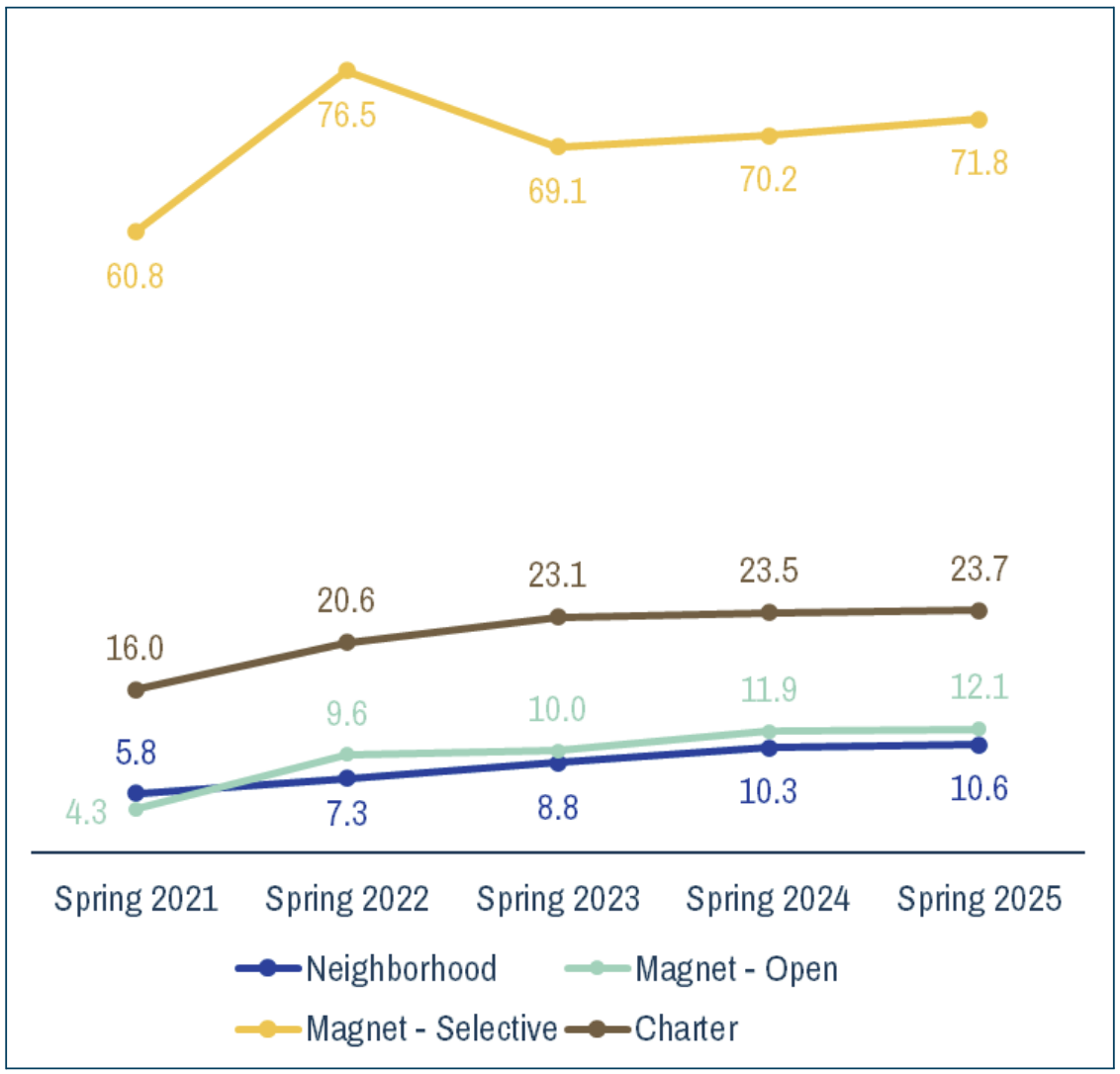
Math proficiency has increased across all public school types post-pandemic. Math proficiency was lowest in spring 2021 and has increased across all public school types over the past five years (Figure 2). Neighborhood school average Math proficiency was approximately five percentage points higher in spring 2025 than in spring 2021, while Math proficiency in selective magnets increased by 11 percentage points. Open magnets and charter schools made gains of approximately eight percentage points since spring 2021. However, overall Math proficiency remains lower than ELA proficiency for all public school types.
FIGURE 2
Math Proficiency Highest in Selective Magnets, Increased Across All Types Post-Pandemic
Elementary and Middle Grade Math Proficiency by Five Public School Types (Spring 2021–Spring 2025)
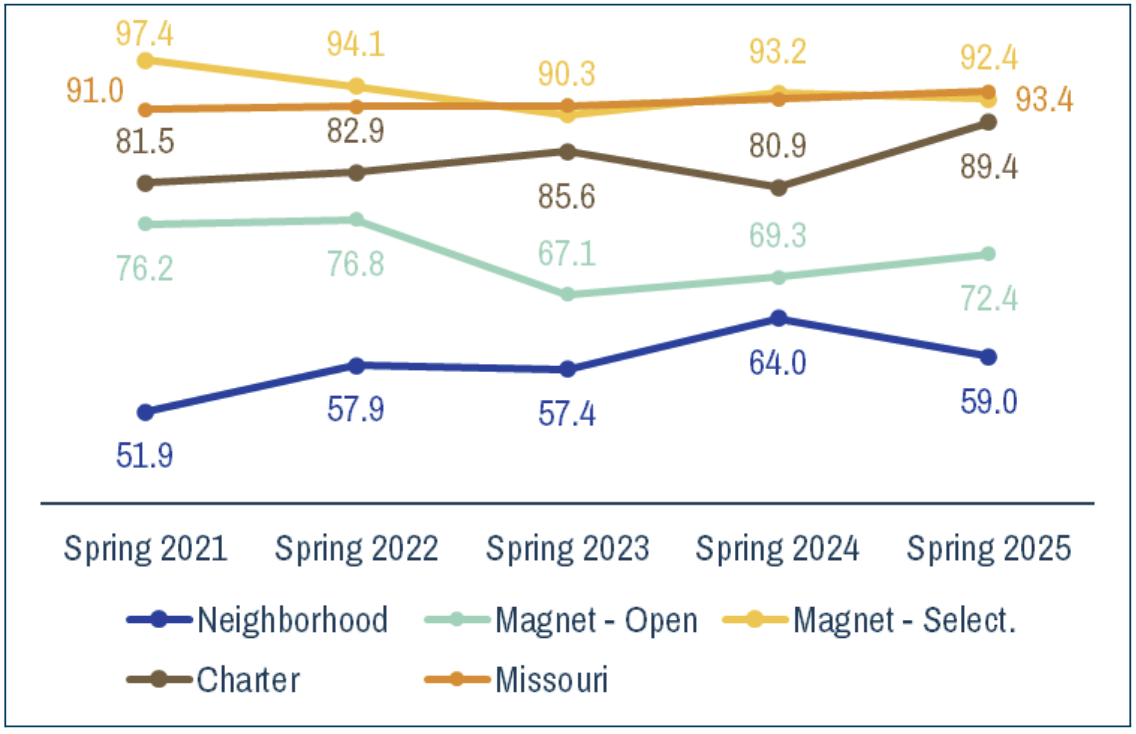
Graduation rates have increased in charter and neighborhood high schools. SLPS selective magnet high schools (4 schools in 2025–26) consistently have the highest adjusted cohort graduation rates in the city, followed by charters (8 schools), open magnets (3 schools), and neighborhood high schools (3 schools; Figure 3). However, the average graduation rate for the city’s selective magnets was highest in spring 2021 and has decreased by five percentage points since then, falling slightly below the state average in 2023 and 2025. Graduation rates also initially declined among open magnets but have begun to increase over the past two years. Meanwhile, the average graduation rate in the city’s charter high schools reached its highest level in spring 2025, and graduation rates in the city’s three neighborhood high schools are also higher now than in spring 2021.
FIGURE 3
Graduation Rates Have Increased in Neighborhood and Charter High Schools
Adjusted Cohort Graduation Rates by St. Louis City Public School Types (Spring 2021–Spring 2025)
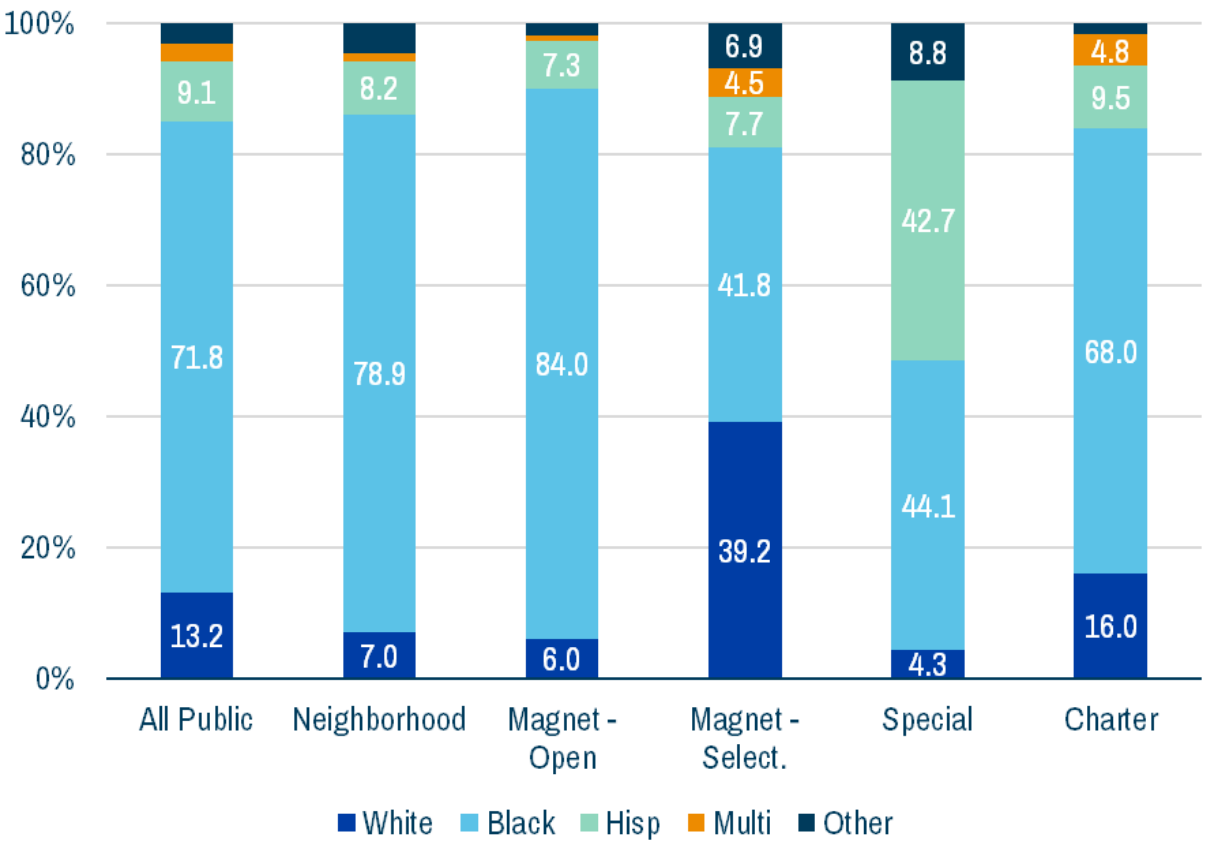
The third blog in this series examined racial demographics and poverty rates across public school types. Students from low-income families have historically been concentrated in SLPS neighborhood and open magnet schools, while selective magnets serve a more economically-advantaged population than do other public school types. The known correlation between family income and student academic outcomes should inform our assessment of the academic performance of different types of schools.
TABLE 1
St. Louis City Has Five Types of Public Schools
Definitions of St. Louis City Public Schools Types
MORE FROM THE PRiME BLOGS

Here we report on the percent of students who are scoring at the proficient or advanced levels in ELA and math, for schools serving elementary and middle-grade students.