
How Did School District Consolidations Create the Current District Map in St. Louis County, and Why is Consolidation Back on the Table?
By: Amy Shelton, Ph.D. and Joseph Nichols, Ph.D.
St. Louis County, Missouri is divided into 22 regular school districts that vary widely in geographic size and student enrollment, from 668 students in Valley Park to 18,595 students in Rockwood R-6 (2025–26). Student demographics and funding also differ starkly across districts. Lindbergh serves a population that is 2.7% Black, while the student population in Riverview Gardens is 96.5% Black (2024–25). And while Jennings and Clayton both serve just over 2,000 students, Jennings had $8,731 to spend per student in 2024–25, while Clayton spent $24,862. What explains the number of districts and the disparities between them?
The History of School District Boundaries in St. Louis
Remarkably, the school district landscape in St. Louis County is less fragmented today than it was in 1948 (Map 1). At the time, the county was divided into 87 small school districts, most of which were “common districts” that served 20 or more children in a single school and only offered education through 8th grade. To address financial inefficiencies and the need for high school education across the state, the Missouri legislature passed Senate Bill 307, which mandated that each Missouri county create a plan for school district reorganization.
MAP 1
There Were 87 Districts in 1948
Map of St. Louis County School Districts (1948)
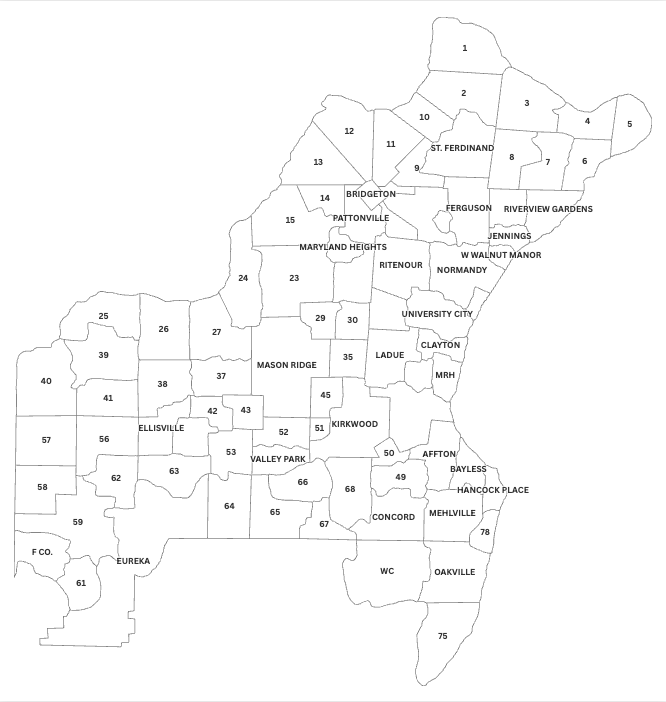
*In 1910, the St. Louis County Court assigned numbers to each of the small, common districts.
In October 1949, St. Louis County voters approved a plan to merge 23 smaller districts into three “reorganization districts,” Eureka/Rockwood R-6, Kirkwood R-7, and Grand View/Lindbergh R-8. The number of districts was reduced further through a second reorganization vote in October 1951, which created the districts of Hazelwood R-1, Ferguson-Florissant R-2, Pattonville R-3, and Mehlville R-9. The last major district merger occurred in 1954, when the majority of voters in the Fern Ridge, Mason Ridge C-2, and Weber districts voted to form a consolidated high school district, Parkway C-2. Most of the remaining small districts were annexed by neighboring districts during the 1960s.
School District Segregation in St. Louis
When the U.S. Supreme Court ended legal school segregation in 1954, one-third of the 4,253 Black students in St. Louis County went to school in the all-Black, North County district of Kinloch. Only 17 of the other 29 districts had a Black student population. Fourteen operated separate schools for Black students, and three sent their Black students to other districts for school. Berkeley sent Black students to Kinloch, Ladue sent Black students to Clayton, and Normandy sent Black students to Wellston. All county districts sent Black high school students to St. Louis City, until the Webster Groves district opened Douglass High School for Black students in 1928. It remained the only Black high school in the county until Kinloch High School opened ten years later.
District reorganizations in 1949 and 1951 conspicuously excluded Kinloch. Two decades later, the U.S. Justice Department sued the State of Missouri for creating the all-Black district and then intentionally maintaining the segregation of Kinloch through the school district reorganization process. In 1975, federal courts ordered Ferguson-Florissant R-2 to absorb Kinloch and neighboring all-White Berkeley into one fully integrated school district. This was the last change to the school district map until 2010, when the state ordered Normandy to absorb the struggling district of Wellston (Map 2).
MAP 2
There Are 22 Regular School Districts in 2026
Map of St. Louis County School Districts (2026)
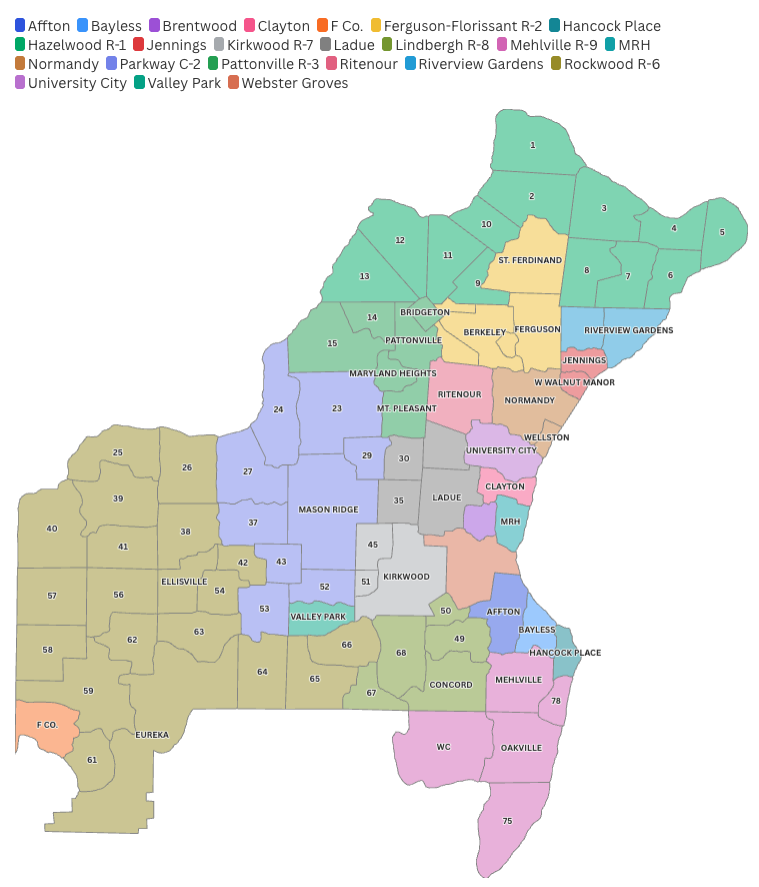
Racial segregation and funding disparities across St. Louis County school districts today are a legacy of housing discrimination in the early and mid decades of the 20th century and the resulting disparities in property values throughout the region. White flight from St. Louis City and its inner-ring suburbs in the 1960s and 1970s resulted in the racial transition of districts like Normandy, Jennings, and University City from majority-white to majority-Black. Other districts, such as Ladue and Clayton, remained majority-White and wealthy because of exclusionary zoning (e.g., minimum lot sizes and restrictions on housing types).
The limited step of merging Kinloch and Berkeley into Ferguson-Florrisant R-2 is the only example of altering school district boundaries in the county to promote integration. Federal courts later ordered the creation of a massive voluntary interdistrict busing program (VICC) to address school segregation across the region, but the solution failed to address segregating boundary lines and thus had little lasting impact on district demographics.
Conclusion
The school district landscape in St. Louis County is less fragmented today than it was prior to school district reorganizations under SB 307. However, the remaining district boundaries are not neutral or passive administrative lines. They represent values, effectively separate students by race, and often restrict who has access to educational opportunity in our region. School district boundaries have implications for housing patterns, racial segregation, and the allocation of financial resources. District boundary lines have histories, and those histories matter for how we learn to live together and craft our collective futures.
School district boundaries are not static: they are not permanently set in stone. The current school district map was created through a series of district consolidations, annexations, and reorganizations. Today, the STL Region Future of Public Education Task Force is considering four options for voluntary district consolidations or reorganizations to prevent a state takeover of the Normandy school district and to address financial challenges faced by area districts.
SB 307 was intended to address the problem of financial inefficiencies across small school districts in what was rural St. Louis County. District consolidations today may address similar financial challenges. However, the school district consolidation conversation among local and state policymakers should not ignore state disinvestment in public education and the need to adequately fund the region’s public schools.
Published September 2026
MORE FROM THE PRiME BLOGS
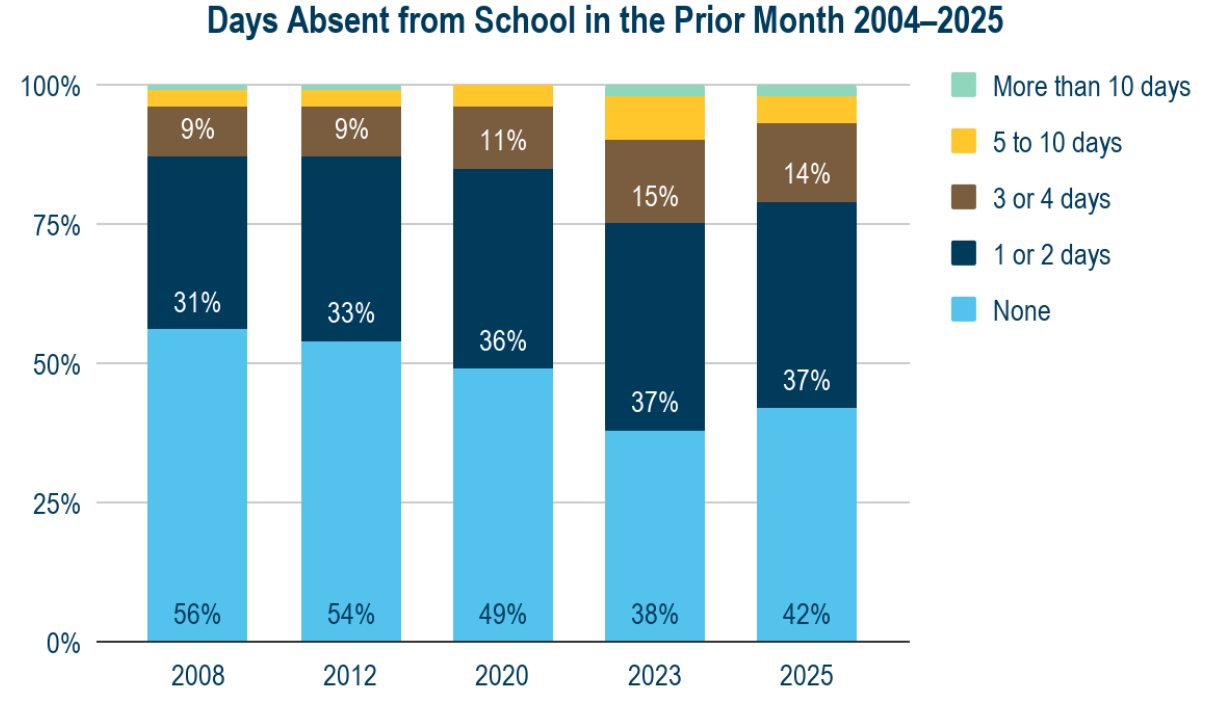

In 2025, NAEP administered its quadrennial Long-Term Trends Assessment for 9- and 13-year-olds. Today, we are going to be looking at three things we learned about 9-year-olds from the recently released results.