
Over 34,000 Missouri Students Lacked Stable Housing Last School Year—Here’s Why That Matters
By : Deanna Childress Ph.D
Published On: July 2, 2025
In Missouri, student homelessness is not just a growing crisis—it’s an urgent education policy issue. According to our new report, more than 34,000 students in Missouri’s public schools were identified as experiencing homelessness during the 2022–23 academic year. That’s 1 in every 25 students, far higher than the national average. While Missouri makes up just 1.8% of the U.S. population, it accounts for 2.5% of all students identified as homeless nationwide—an over-representation that demands serious attention.
Many assume student homelessness is most visible in shelters or on the streets. But our findings challenge that image. More than 80% of students identified under the McKinney-Vento Homeless Assistance Act were “doubled up”—living with friends or relatives due to loss of housing or economic hardship. These students often remain hidden from public view, yet they face enormous challenges that can disrupt learning, attendance, and emotional well-being—factors strongly tied to increased student mobility.
Figure 1 : More than 80 Percent of Homeless Students are “Doubled Up” Living with Other Families
Count of McKinney-Vento Students in Missouri by Shelter Type, 2003-04 – 2022-23

The report also tracks how student homelessness in Missouri has nearly tripled since 2004, despite fluctuations in federal data. In fact, the number of Missouri students identified through McKinney-Vento rose 81% between 2011 and 2023, signaling a long-term upward trend, not a temporary spike.
These figures highlight more than just numbers—they reveal persistent, systemic instability affecting thousands of children across our state. If left unaddressed, student homelessness will continue to undermine educational equity and long-term academic success.
Our report calls for increased awareness, stronger school-based supports, and targeted policy interventions to meet the needs of students facing homelessness. Understanding the scope and nature of this issue is the first step toward crafting solutions that ensure every student—regardless of housing status—can access a stable, high-quality education.
Read the full report to learn more about the trends, challenges, and recommendations: https://www.primecenter.org/education-reports-database/homelessness
MORE FROM THE PRiME BLOGS

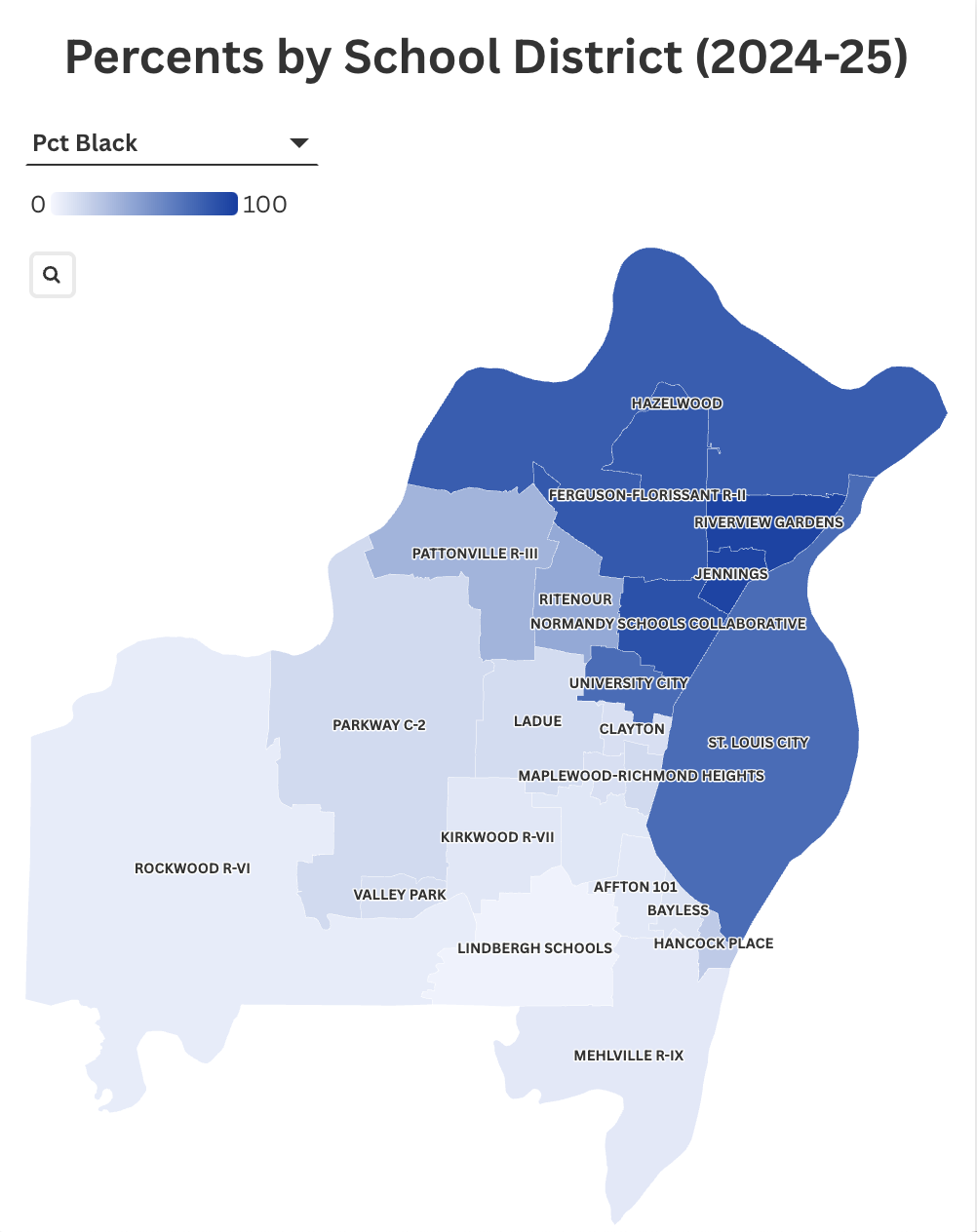
St. Louis County, Missouri is divided into 22 regular school districts that vary widely in geographic size and student enrollment, from 668 students in Valley Park to 18,595 students in Rockwood R-6 (2025–26). Student demographics and funding also differ starkly across districts. Lindbergh serves a population that is 2.7% Black, while the student population in Riverview Gardens is 96.5% Black (2024–25). And while Jennings and Clayton both serve just over 2,000 students, Jennings had $8,731 to spend per student in 2024–25, while Clayton spent $24,862. What explains the number of districts and the disparities between them?